|
|
| Page 1 2 3 4 | |
| transcript : |
One of the things I like best about your work is what I take to be the meeting of imaginative vision and physical vision. Sometimes, when I look at your numbers, I imagine other numbers. |
| Tatsuo Miyajima : | I want the audience to bring whatever they can or whatever they must to the work. Then it is not what we can do with numbers, it is what numbers can do for us. In our consciousness. [Takes up a pen, writes: ART IN YOU.] |
| t : | What significance does colour have for your work? You have worked with red and green, and now the technology has allowed you to use blue in your new piece |
| M  : |
Kandinsky s theory was that yellow is a triangle, red is a square and blue is a circle. Blue is crucial, and it is connected to the circular form, because blue is unformed. It escapes, and in a sense is not there. We must put the ultimate form around it. |
| t : | An archetypal form? |
| M  : | Yes, an ultimate form around it. A circle. The symbol of the universe and infinity. |
| t : | The sky. The sky is inextricably linked in imagist thinking with blue. We say sky blue, but the is sky difficult to talk about in terms of colour. We cannot hold colour for long without form. Where and what is the sky? |
| M  : |
Sky is invisible. It is not a solid. When I lie down in a field I look at the sky. I cannot begin to think about measuring it. I think of sky both as very close and at a distance I think of the sky as the first clock. I also think of the sky as a potent source of creative imagination, Yves Klein made international klein Blue out of the sky. But the sky is invisible. Yes, where is the sky? |
| t : | Moving from a blue circle to the framing devices in your work, could you comment on the frame? |
| M  : |
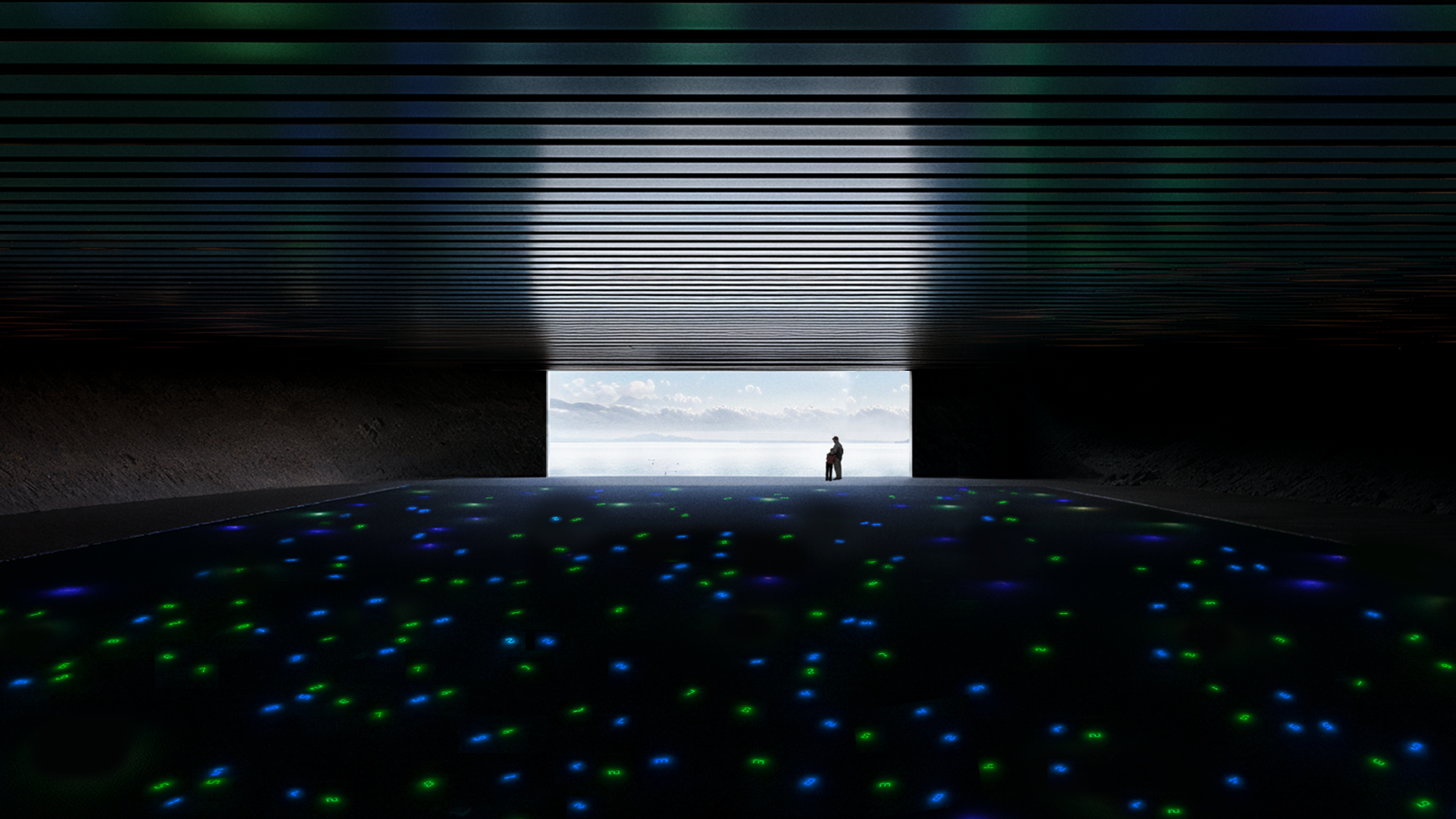
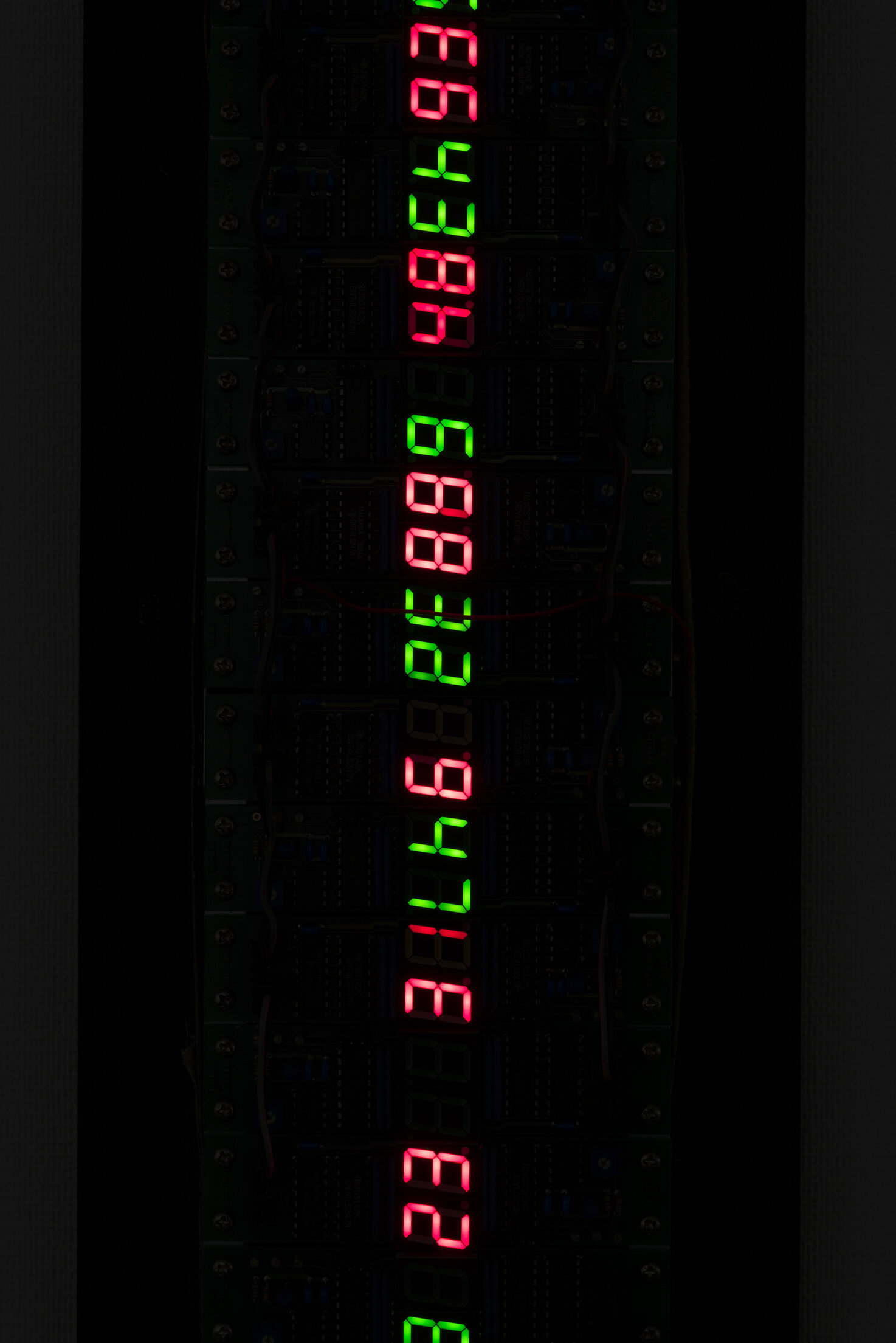
That which is in a frame always seems to be on the point of escaping. Even with the frame there is instability. My piece Time in Blue has a panel frame. Normally I want the frame to be invisible or not there at all. But in this case, the frame is literally a framing device, because Time in Blue refers to the sky. The numbers are arranged in chaos positions but the frame provides logic. It is like the window frame which seems to contain the (invisible) sky. |
| t : | And do you connect foaming with naming? |
| M  : | I use names to tell things apart, and also to connect things together. |
|
Postscript Tatsuo miyajimas awareness of the premillenium counting down metaphor was evidenced by his counting conference performance, staged at the Heyward Gallery on 24th June 1997. Twelve people counted in twelve languages from nine to one. They were positioned at a round conference table like twelve markers on a clock face. They counted down in their own time. Notes 1. Saint Augustine, Confessions Book XI. Time and Eternity, xxlli. 2. From notes taken doing first meeting. 3. Following the dissemination of Albert Einsteins ideas about Brownian motion (the erratic zigzagging of a particle suspended in fluid resulting from molecular bombardment) and Werner Heisenbergs theories, which became popularly known as the uncertainty principle, quantum cosmology moved into a new phase of reasoning associated with Stephen Hawkin, James Hartle and Murray Gell-Mann. 4. Marie-Louise von Franz, Number and Time, Northwestern University Press, 1974. 5. Kasimir Malevich in a letter to Mikhail Matiushin, May 15, 1915. Malevichs exhibition 0-10 opened in Petrograd on December 15, 1915. Cited in Chariotte Douglas, Swans of Other Worlds: Kasimir Malevich and the Origins of Abstraction in Russia, Ann Arbor, IJMI, 1980. p54. 6. Saint Augustine, op. cit, Book XI, xxIII. 7. Kansas City, Little Richard. |
|
Transcript vol.3 Issue 1 pp 4 -19 |
| Page 1 2 3 4 |
|
|
||