TEXT BY ARTIST > INTERVIEW  > TRANSCRIPT VOL.3  (1)
Page   1     2     3     4
transcript  : How does your previous work, including the performance work, connect to your current preoccupations?
Tatsuo Miyajima  : My performance work has its origins in 1980, when I was a student at art school. I was interested in performance art for five years and then stopped for ten years, during which time I turned to the idea that objects might be perpetually transforming, not solid state. And then I began making objects with this in mind. I started making objects which I wanted to be essentially unstable. I became involved in the potential of light and movement. Eventually I realised that, in a different way from live performance, these new objects involving movement and involving light were performing.

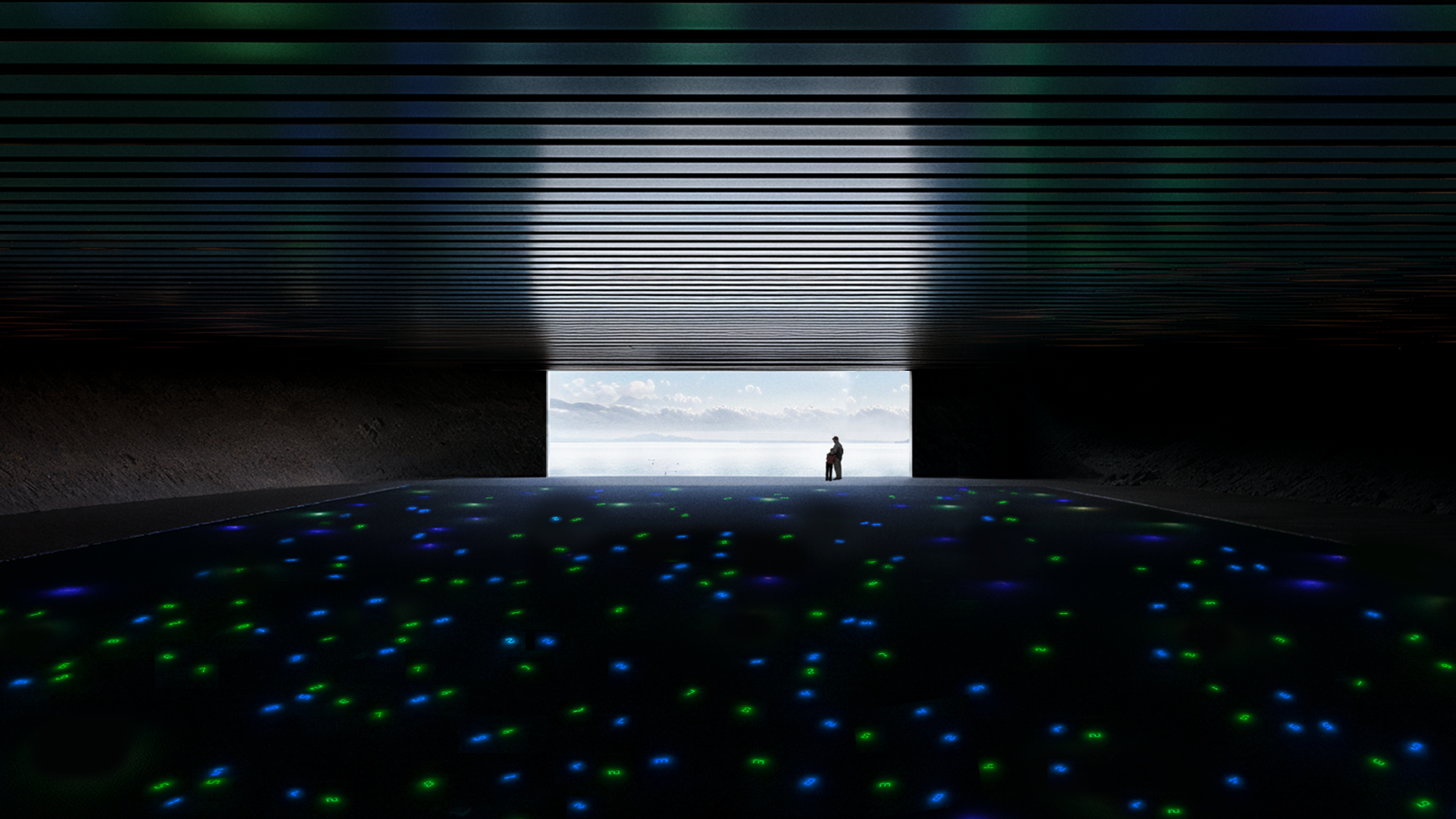
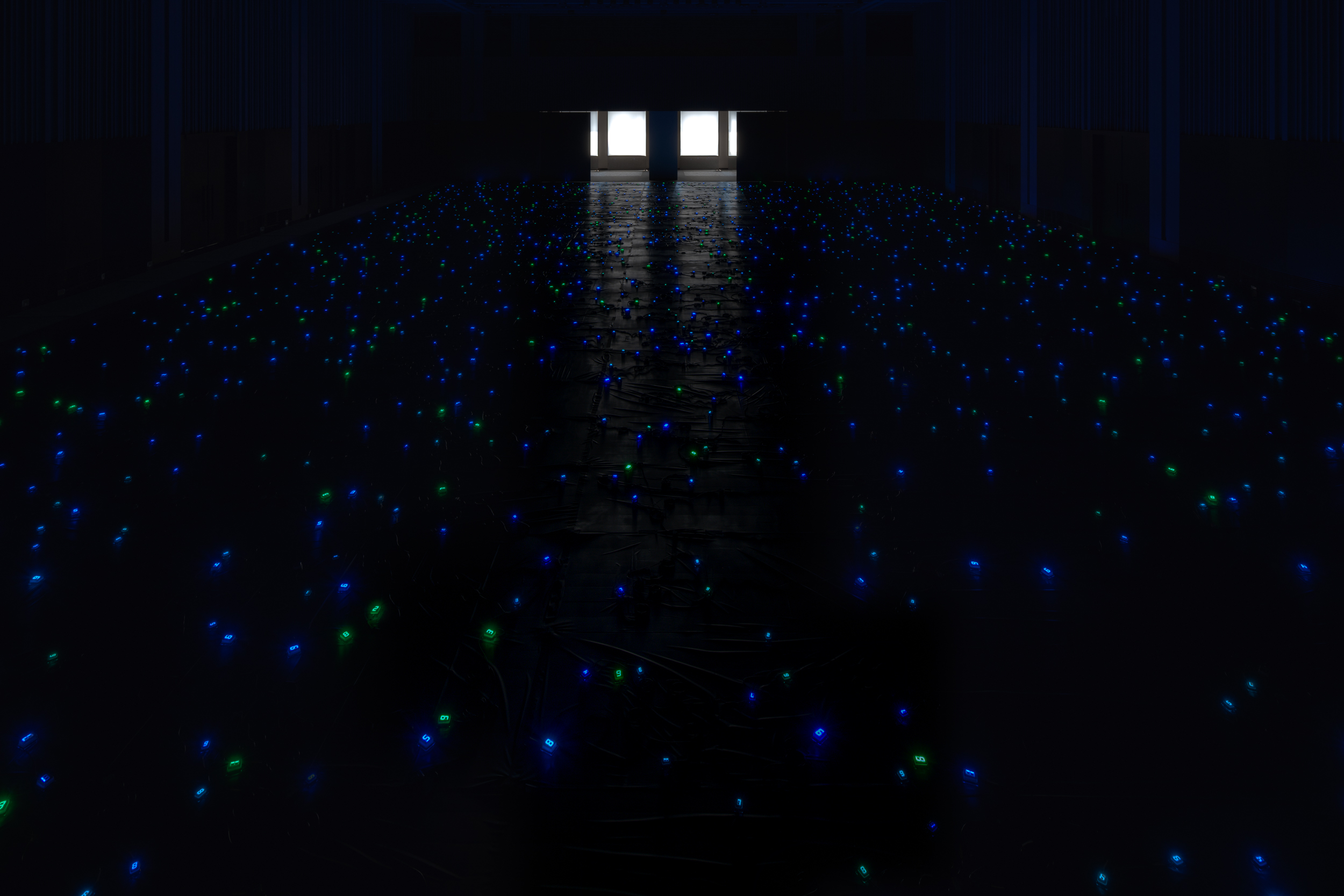
For these object-based performance pieces I wanted a larger, and more international, audience than had been possible for the live performances, although I had been attracted to the temporality of live performance, and still am. With the object-based performance pieces I became reconciled to a certain degree of temporality, because the audience would need to visit a specific venue, often a gallery, to encounter the work. The audience was a further agent of change. The audience was never, or perhaps rarely, of the same composition twice. I then started to consider my work as a performance installation. I wanted the object to be as active as possible, so that the performance installation would be a ‘live performance’. This would then create a different relationship between art and its audience.
t : Numbers in your art work are part of a figural, literal, physical and therefore associative set of experiences, and at the same time abstract…
M  : [In English] Difficult question.
I think that numbers register with us and we connect with them because they are both of these states to which you refer, the figural and the abstract.
t : We think about numbers, and some of us think of them as quantified and quantifiable. We imagine they relate to sizes, amounts, weights, ratios and so on. We often think of them as gains and losses. It is difficult not to attach a personal meaning to them. They calibrate the rituals of our individual and collective lives. But we do not really understand much about numbers. Most of us could not define the term "pure mathsç, for" instance. At such times we realise that we cannot firmly attach a number to something and sustain a logical argument. So numbers are caught between the meanings we attach to them and no meaning…
M  : This raises a serious philosophical issue because with numbers we do veer between the figural and the abstract. We do the same with language. We oscillate and drift between the two with a frequency we do not care, or remember, to analyse.
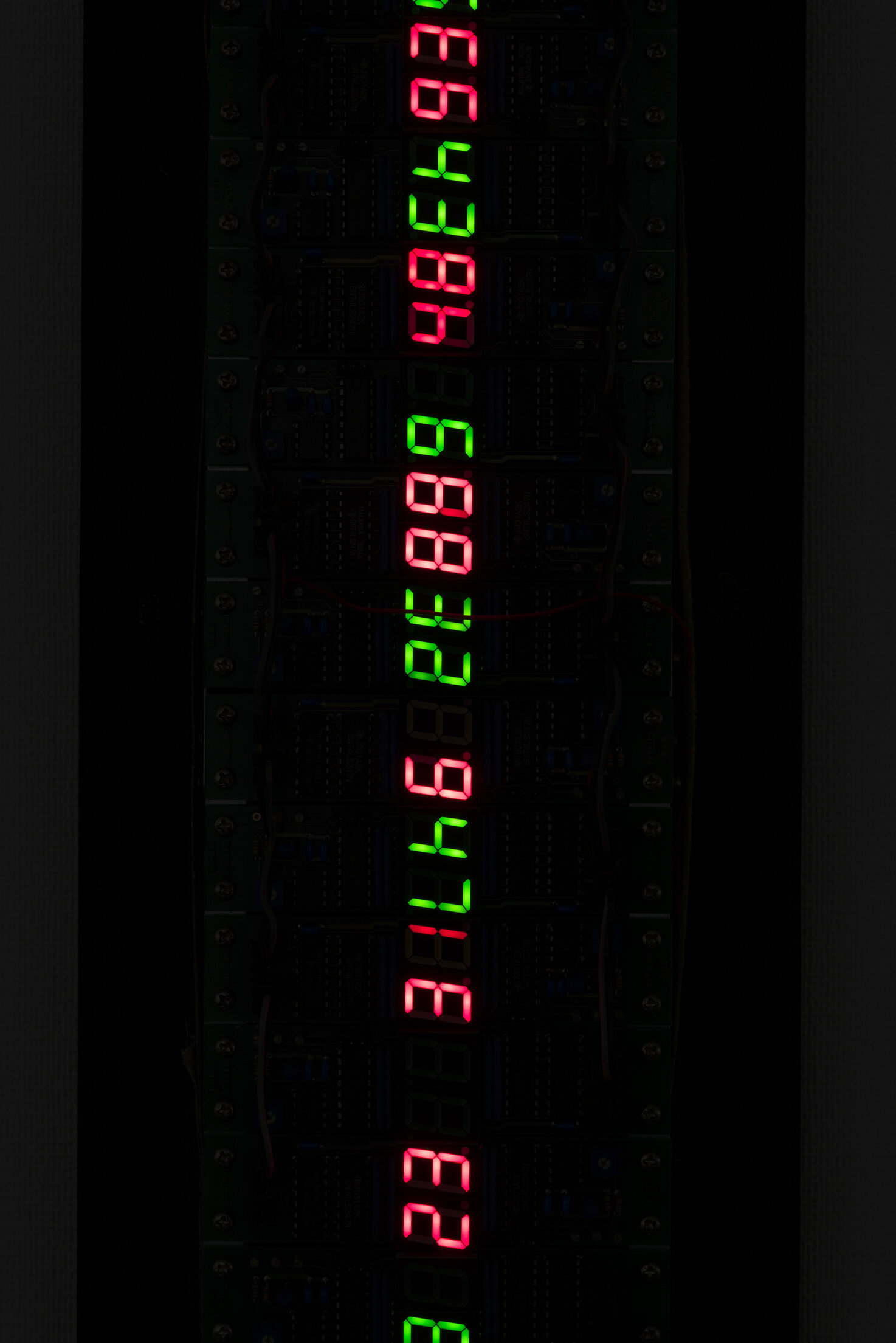
t : Digital number LED (Light Emitting Diode) technology can be used to create the digit 0-9 (and therefore all numbers ad infinitum) together with a limited number f European alphabet based letterforms Œ upper case A, lower case B, and so on. How, in terms of what it is and what it can do, does LED technology have a bearing on your work?
M  : I discovered LED in Tokyo, in relation to both its more complex technical aspects and its conceptual potential. LED helped me formulate my core concept which has been quoted elsewhere: keep changing, connect with everything, continue for ever.

There were these numbers which, if they were randomly processed, would set up all sorts of mental associations which varied according to the audience. And they would just keep going, creating changing associations.

When I thought about LED, I realised it was a technology working parallel with my concerns and ambitions. Of all technological developments, it epitomises my thinking about numbers: and it has light and movement which produces a sense of life – almost.

As you say, digital number LED has all the numbers from 0 to 9 infinity, in every direction. All the numbers can be found in LED. Digital numbers have all ten numbers contained in one. This number has everything. Number is everything.
I make digital number LED a metaphor for human beings because everyone has ten words connected to their lives.
When I think of all numbers in one, it follows that the whole is made up of all of its parts. Heisenberg said as much about the universe and about time, and I was immediately struck by his understanding of apparently complex but ultimately simple relationships between things. And the things that are perhaps as yet unknown.
t : If you know where an electron is, you are vague about its motion; If you know how it is moving, you cannot know where it is?
M  : Yes. That is an important point about the object, movement, space and time principle. LED devices can be interconnected, and this works well with what I am trying to do in relation to connecting things, or in trying to suggest a connectivity.
Page   1     2     3     4